Dinamarca


Antigo país dos vikings e mais tarde uma grande potência do norte europeu, a Dinamarca passou a ser uma nação moderna e próspera, integrada à União Européia.

Foi organizada pela primeira vez como um estado unificado no século 10. Em 1849 tornou-se uma monarquia constitucional.

Inundações é uma ameaça em algumas áreas do país (por exemplo, em Jutland, na costa meridional da ilha de Lolland) que estão protegidos contra o mar por um sistema de diques.


Dinamarca


Country name: Kingdom of Denmark (local: Kongeriget Danmark).

Capital: Copenhagen.

Government type: Constitutional monarchy .

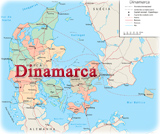
Total area: 43,094  km². It includes the island of Bornholm in the Baltic Sea and the rest of metropolitan Denmark (the Jutland Peninsula, and the major islands of Sjaelland and Fyn), but excludes the Faroe Islands and Greenland.

Coastline: 7,314 km.

Highest point: Yding Skovhoej 173 m.

Climate: Temperate; humid and overcast; mild, windy winters and cool summers .

Administrative divisions: metropolitan Denmark - 14 counties (amter, singular - amt) and 2 boroughs (amtskommuner, singular - amtskomunes); Arhus, Bornholm, Fredericksberg, Frederiksborg, Fyn, Kobenhavn, Kobenhavns, Nordjylland, Ribe, Ringkobing, Roskilde, Sonderjylland, Storstrom, Vejle, Vestsjalland, Viborg note: see separate entries for the Faroe Islands and Greenland, which are part of the Kingdom of Denmark and are self-governing overseas administrative divisions.

Terrain: low and flat to gently rolling plains.

Ports and harbors: Aabenraa, Aalborg, Aarhus, Copenhagen, Esbjerg, Fredericia, Frederikshavn, Hirtshals, Kolding, Odense, Roenne (Bornholm), Vejle.

Note: Denmark controls Danish Straits (Skagerrak and Kattegat) linking Baltic and North Seas.

Fonte principal: CIA - The World Factbook 2004.


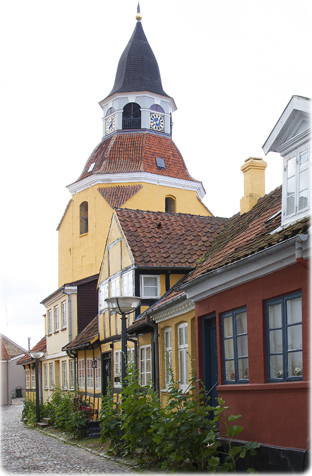
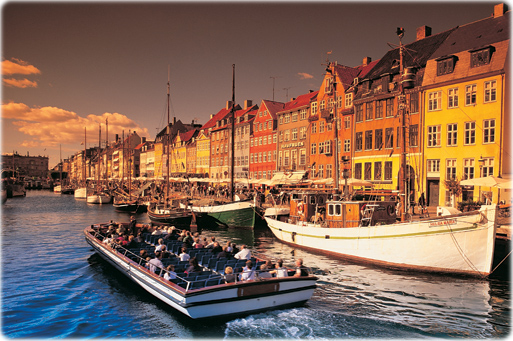
Ruas de Copenhague e a torre da igreja Saint Nickolus, ao fundo. A história da igreja remonta ao século 13. Um incêndio em 1795, deixou apenas a torre. O prédio, reconstruído em 1914-1917, é atualmente um centro para exibições da prefeitura.


Europa Viagem


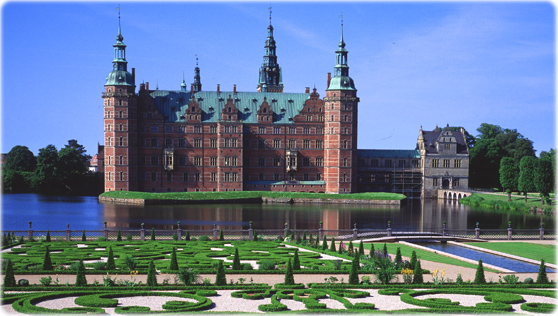
Fredericksborg Castle


Economia

This thoroughly modern market economy features high-tech agriculture, up-to-date small-scale and corporate industry, extensive government welfare measures, comfortable living standards, a stable currency, and high dependence on foreign trade. Denmark is a net exporter of food and energy and enjoys a comfortable balance of payments surplus. Government objectives include streamlining the bureaucracy and further privatization of state assets. The government has been successful in meeting, and even exceeding, the economic convergence criteria for participating in the third phase (a common European currency) of the European Economic and Monetary Union (EMU), but Denmark has decided not to join 12 other EU members in the euro; even so, the Danish Krone remains pegged to the euro. Given the sluggish state of the European economy, growth in 2003 was a mere 0.3%.

Currency: Danish krone (DKK). Danish kroner / US dollar = 6.59 (2003).

GDP (purchasing power parity):  US$ 167.7 billion (2003 est.).

GDP per capita (purchasing power parity):  US$ 31,200 (2003 est.). 


Mapa Copenhague


Copyright © Guia Geográfico - Dinamarca, Europa - Países da Escandinávia


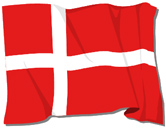
Denmark Flag


Mapa da Dinamarca


Dinamarca


Mapas Europa


Links: Dinamarca

Denmark Tourism

The Danish Monarchy

Tivoli Park - Copenhagen

Faroe Islands Tourist Board

Copenhagen.com

Museum of Decorative Art

National Gallery, Copenhague

National Museum, Copenhague

União Européia►

Turismo na Europa►


◄Europa

◄Escandinávia


Kronborg Castle official site


Fredericksborg Castle, in Hillerød, Denmark. Built on three small islands in the 17th century, in Dutch Renaissance style. Today it is the national portrait gallery, with paintings of the royal family members, since the 16th. 


Kronborg Castle, in Elsinore, Denmark. It is a renaissance castle and a military fortress, known all over the world from Shakespeare's Hamlet.


População

Population: 5.4 million (July 2004 est.). About one-quarter of the population lives in greater Copenhagen.

Population growth rate: 0.35 % (2004 est.).

Life expectancy at birth: 77.4 years.

Religions: Evangelical Lutheran 95%, other Protestant and Roman Catholic 3%, Muslim 2%.

Ethnic groups: Scandinavian, Inuit, Faroese, German, Turkish, Iranian, Somali.

Language: Danish, Faroese, Greenlandic (an Inuit dialect), German (small minority). English is the predominant second language .

Nationality: noun: Dane(s). Adjective: Danish.


Kronborg Castle