Lituânia


População

Population: 3.6 million (July 2004).

Population growth rate:

-0.33 % (2004).

Life expectancy at birth:

73.5 years.

Religions: Roman Catholic (primarily), Lutheran, Russian Orthodox, Protestant, Evangelical Christian Baptist, Muslim, Jewish.

Ethnic groups: Lithuanian 80.6%, Russian 8.7%, Polish 7%, Belarusian 1.6%, other 2.1%.

Languages: Lithuanian (official), Polish, Russian.

Nationality: Lithuanian(s).


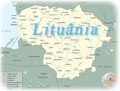
Mapa da Lituânia


Lithuania Flag


Lithuania map


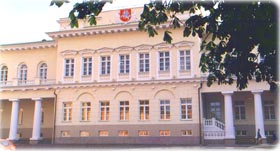
Palace in Vilnius, Lithuania


Links -Lituânia

Lithuania Official Travel Guide

Vilnius City Guide

Museums of Lithuania

Statistical Bureau of Latvia

Baltic Sea Tourism

Vilnius University

Viagem Europa


Geografia

Country name: Republic of Lithuania (local: Lietuvos Respublika).

Capital: Vilnius.

Government type: parliamentary democracy.

Independence: 11 March 1990 (independence declared from Soviet Union); 6 September 1991 (Soviet Union recognizes Lithuania's independence).

Administrative divisions: 10 counties (apskritys, singular - apskritis); Alytaus, Kauno, Klaipedos, Marijampoles, Panevezio, Siauliu, Taurages, Telsiu, Utenos, Vilniaus.

Terrain: lowland, many scattered small lakes. Fertile central plains are separated by hilly uplands that are ancient glacial deposits.

Total area: 65,200 km².

Coastline: 99 km.

Highest point: Juozapines / Kalnas 292  m.

Climate: transitional, between maritime and continental; wet, moderate winters and summers.

Ports and harbors: Butinge, Kaunas, Klaipeda.


Independent between the two World Wars, Lithuania was annexed by the USSR in 1940. On 11 March 1990, Lithuania became the first of the Soviet republics to declare its independence, but Moscow did not recognize this proclamation until September of 1991 (following the abortive coup in Moscow). The last Russian troops withdrew in 1993. Lithuania subsequently restructured its economy for integration into Western European institutions. Lithuania joined both NATO and the EU in 2004.


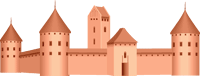
Trakai Castle in southeastern Lithuania.


Fonte principal: CIA - The World Factbook 2004.


Vilnius Lithuania


Economia

Lithuania, the Baltic state that has conducted the most trade with Russia, has slowly rebounded from the 1998 Russian financial crisis. Unemployment remains high, still 10.7% in 2003, but is improving. Growing domestic consumption and increased investment have furthered recovery. Trade has been increasingly oriented toward the West. Lithuania has gained membership in the World Trade Organization and has moved ahead with plans to join the EU. Privatization of the large, state-owned utilities, particularly in the energy sector, is nearing completion. Overall, more than 80% of enterprises have been privatized. Foreign government and business support have helped in the transition from the old command economy to a market economy.

GDP (purchasing power parity): US$ 40.88 billion (2003).

GDP per capita (purchasing power parity): US$ 11,400 (2003)

GDP growth rate: 9 % (2003).

Unemployment rate: 10.3 % (2003).

Currency: litas (LTL).

Industries: metal-cutting machine tools, electric motors, television sets, refrigerators and freezers, petroleum refining, shipbuilding (small ships), furniture making, textiles, food processing, fertilizers, agricultural machinery, optical equipment, electronic components, computers, amber.

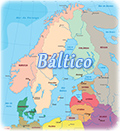
Mapa Mar Baltico


Trakai Castle in southeastern Lithuania.


Façade of the Presidential Palace in Vilnius, Lithuania (photo www.president.lt).


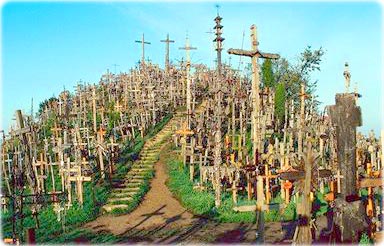
Cross Hill, Siauliai District, Lithuania. Since the 19th century, people from from all over Lithuania and other countries erect crosses on this Hill in gratitude to God.


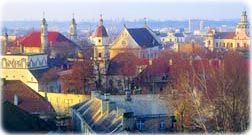
Vilnius, capital da Lituânia (foto www.turizmas.vilnius.lt).


Castle LithuaniaLithuania

Copyright © Guia Geográfico

Google