Vaticano


Viagem Europa


População

Population: 921 (July 2004).

Religion: Roman Catholic.

Ethnic groups: Italians, Swiss, other.

Languages: Italian, Latin, French etc.


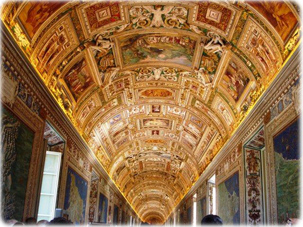
God resurrected Christ with the Virgin Mary at His side. The Sistine Chapel Ceiling, painted by Michelangelo for Pope Sixtus IV.  These Michelangelo's paintings are the Heaven for itself.


Vatican Flag
Mapa Vaticano


Hole See

Links - Vaticano

Vatican the Holy See

Congregation for the Clergy

Vatican Radio

Paxbook.com Vatican Bookstore


Geografia

Country name: The Holy See (State of the Vatican City). Local: Santa Sede (Stato della Citta del Vaticano).

Government type: ecclesiastical. Constitution: new Fundamental Law promulgated by Pope John Paul II on 26 November 2000, effective 22 February 2001 (replaces the first Fundamental Law of 1929).

Independence: 11 February 1929 (from Italy). Note: on 11 February 1929, three treaties were signed with Italy which, among other things, acknowledged the full sovereignty of the Vatican and established its territorial extent; however, the origin of the Papal States, which over the years have varied considerably in extent, may be traced back to the 8th century.

Total area: 0,44 km². An enclave of Rome, Italy. The world's smallest state; outside the Vatican City, 13 buildings in Rome and Castel Gandolfo (the pope's summer residence) enjoy extraterritorial rights.

Climate: temperate; mild, rainy winters (September to mid-May) with hot, dry summers (May to September).

Note: defense is the responsibility of Italy; Swiss Papal Guards are posted at entrances to the Vatican City to provide security and protect the Pope.


In 1984, a concordat between the Holy See and Italy modified certain of the earlier treaty provisions, including the primacy of Roman Catholicism as the Italian state religion. Present concerns of the Holy See include religious freedom, international development, the Middle East, terrorism, the death of Pope John Paul II (1920-2005), interreligious dialogue and reconciliation, and the application of church doctrine in an era of rapid change and globalization. About 1 billion people worldwide profess the Catholic faith.


In 1870, the pope's holdings were further circumscribed when Rome itself was annexed. Disputes between a series of "prisoner" popes and Italy were resolved in 1929 by three Lateran Treaties, which established the independent state of Vatican City and granted Roman Catholicism special status in Italy.


Popes in their secular role ruled portions of the Italian peninsula for more than a thousand years until the mid 19th century, when many of the Papal States were seized by the newly united Kingdom of Italy.


Fonte principal: CIA - The World Factbook 2004.


Economia

This unique, noncommercial economy is supported financially by an annual contribution from Roman Catholic dioceses throughout the world, as well as by special collections (known as Peter's Pence); the sale of postage stamps, coins, medals, and tourist mementos; fees for admission to museums; and the sale of publications. Investments and real estate income also account for a sizable portion of revenue. The incomes and living standards of lay workers are comparable to those of counterparts who work in the city of Rome.

Currency: euro (EUR).

Industries: printing; production of coins, medals, postage stamps, a small amount of mosaics and staff uniforms; worldwide banking and financial activities.


Basílica de São Pedro, Santa Sé.


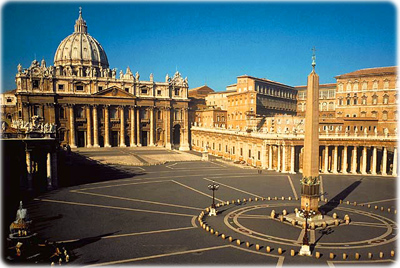
Praça de São Pedro na Cidade do Vaticano.
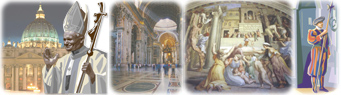
 

Saint Peters BasilicaSistine Chapel

Copyright © Guia Geográfico

Google